 |
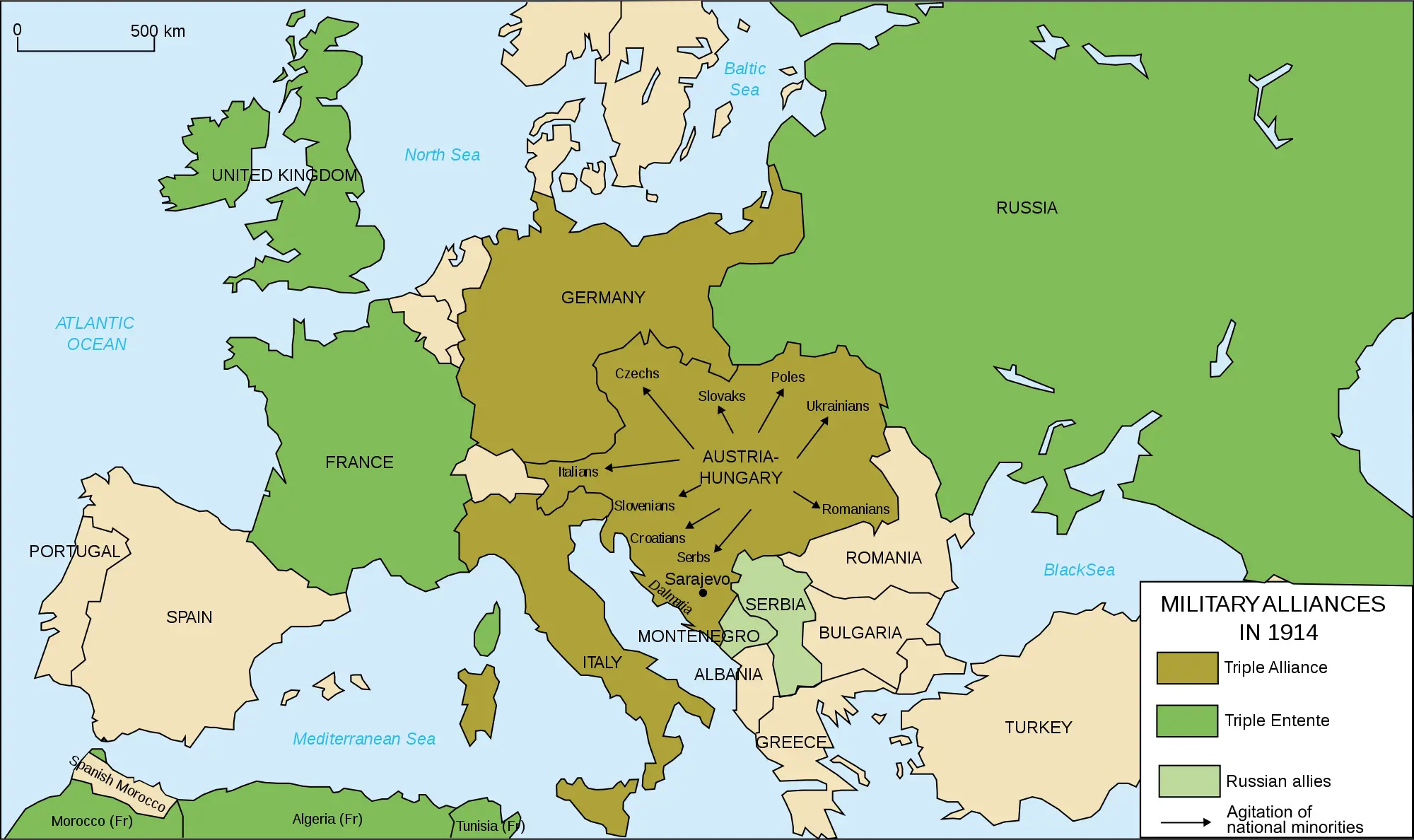
| 1914 Europe. |
^_^
The conflicts between Austria-Hungary and Serbia chiefly concerned the ownership of Bosnia and Herzegovina. The Serbs, a nationalistic people, believed they had a natural right to the two provinces. A group of Serbs formed a secret society called ‘the Black Hand’ that attempted to terrorise Austro-Hungarian officials into satisfying Serbia’s territorial aims. Shortly before noon on Sunday, June 28, 1914, Archduke Franz Ferdinand, heir to the throne of Austria-Hungary was assassinated by Gavrilo Princip, a young Bosnian student part of the group. Austria-Hungary suspected its small neighbour, Serbia, and as a result, declared war on Serbia on July 28, 1914.
In 1882, Germany, Austria-Hungary and Italy signed a treaty called the Triple Alliance. It was designed to protect against French and Russian attack.
France succeeded in bringing Great Britain and Russia together. The new agreement linking France, Russia and Great Britain was called the Triple Entente.
It is extremely complicated to explain who declared war on whom so we broke it down:
Though allied to Germany and Australia, Italy was able to avoid entering the fray and declared a policy of neutrality for a while before much later, declaring war on Austria-Hungary.
June 28 Archduke Frances Ferdinand was assassinated.
July 28 Austria-Hungary declared war on Serbia.
July 30 Russia ordered general mobilisation.
Aug. 1 Germany declared war on Russia.
Aug. 3 Germany declared war on France.
Aug. 4 Germany invaded Belgium. Great Britain declared war on Germany.
Though allied to Germany and Australia, Italy was able to avoid entering the fray and declared a policy of neutrality for a while before much later, declaring war on Austria-Hungary.
What was intended as a strictly limited war between Austria-Hungary and Serbia, ended up with the Central Powers at war with the Allies, with some countries who copped some flak from Austria-Hungary. These causes included the growth of nationalism, the system of military alliances that created a balance of power, the competition for colonies and imperialism.
The sacrifice of eleven million achieved nothing, succeeding only in laying down the foundations for another bloody conflict 20 years later. An armistice ended the fighting four years later.
>_<
Thanks to:
The World Book Encyclopaedia 1984, World War I, Volume Twenty-One, World Book
Credit to Horrible Histories for the entry title :D
J.T
Last night there were double eps on Horrible Histories (ABC 3 :DD) and there was this funny section about how all the countries got involved. Click here.

This is a well written post. It was a good idea to break down the information to make it easier to understand. It is a very complex series of events. Thanks for the links to horrible histories on youtube, very humourous. You should watch the Blackadder skit about the origins of WW1:http://www.youtube.com/watch?v=OfIwY4Ej9aM
ReplyDeleteYou cover the relevant information, however it would have been good to provide some context for the alliance system. The alliance system instigated the arms race and created a 'domino effect'. Finally, I am confused by this sentence: 'Though allied to Germany and Australia, was able to avoid entering the fray and declared a policy of neutrality for a while, later declaring war on Austria-Hungary'.
A nicely written post (H).