Thursday, 17 November 2011

Scratch that. How about Plan B?

Thanks to this helpful link.

>.<
Trench warfare developed due to the failure of the Schlieffen Plan. Trench warfare was a form of field fortification, consisting of parallel rows of trenches.
The Tactics of Trench Warfare
+   Bombardment
The idea was to fire shells to destroy the opposition’s communication trenches as well as the front line – this was to prevent reinforcements from reaching the front lines.
+   Creeping Barrage
This well-developed tactic involved the British firing guns and shells, and the soldiers went creeping behind the shells.
+   Digging under
The third tactic involved the soldiers digging a tunnel under No Man’s Land in an effort to reach the enemy without being seen and using the element of surprise to their best advantage. However, the opposition could hear the digging and start to dig too. This led to them meeting in the middle, and a battle was fought underground.

Living Conditions

+   very basic
+   extremely unhygienic
+   very wet, causing trench foot
+   thriving of germs
+   no antibiotics->wounds turning septic->lead to gangrene
+   contaminated food and water
+   little ‘dug-outs’ for sleeping space

Weapons ;D

+   Machine Gun
It has the ability to fire up to 600 bullets every minute. They were very different to the machine guns now, as they were not hand-held but supported by a tripod like thing.

+   Grenades
Early grenades were made from empty food cans but as time progressed the shapes of grenades differed among countries.

+   Gas
It was introduced by the Germans in 1915 but soon everyone was using it. There were many different kinds of gas but the most notorious of them all was mustard gas. This gas was like an acid; it caused blisters on the skin and formed foam in the lungs, which could be fatal. Worst of all, mustard gas was colourless and odourless, so it was almost impossible to detect.


It has been estimated that up to one third of Allied casualties on the Western Front were actually sustained in the trenches. 
>.<

Sunday, 6 November 2011

Where the birds cry.

I circle above the grey terrain, in the grey sky, a splash of speckled brown among the grey faces. Here, I can see the different spectrums of red. The bright vermillion of fresh blood pooling beneath a recruit, the dark maroon of crusty, dried blood on battered uniforms and the livid pink of freshly opened wounds.
A piece of shrapnel had struck my nest and as a father, I watched my unborn children fall into Death’s open arms. My wife died that night of hunger. I was able to live off crackers from the soldiers.
Ah, yes. The soldiers.
They were young and frightened men, their eyes having seen the worse in mankind. What must it be like there below?
Before the war started (I was quite a knowledgeable bird, you see), we lived in the small town of Quedlinburg and we watched as an impertinent boy with a home-done haircut scramble to join the army. Why, he was only 17!
That seventeen year old boy now lies on the bottom of the ditch, the hard lines of his face as old as twenty and his wounds merely messy recollections of his life. Is that within his broken face a sting of remorse? He reminisces that lazy afternoon abuzz with all the restless boys of the town lining up impatiently. He recalls his father giving him a broad smile and an approving thump on the back. He remembers late at night his mother crying in the kitchen.
Why are you crying mother? Aren’t you proud of your son?
I cry out above the roar of the artillery, the sound resonating through the lonely, endless skies, the boundless plains echoing my call. I can hear the deliberate, tumultuous breathing of a dying, old man as he inhales the offensive stench of the earthen trenches and I can see the thin rivulet of warm blood running down the side of his smile.
There are photos of smiling women flecked with dried mud in the trenches. One young soldier, whose callous, brown hand still clings onto a dirty black and white photo, lies on the bottom. He looks up at the bleak sky.
I’m sorry I can’t keep that promise. Take care of yourself. Love, Daddy.
And he closed his eyes peacefully, the roar of the battle dimming into eternal silence.


For fun :D This isn't an actual story, by the way.
Quite frankly, the war really isn’t getting me any benefits. My nest has gone who-knows-where and my wife’s dead. My kids? I’m not even sure. By the way, the tree has gone an unearthly red. Must be the sun. I think, by the branches, is my wife’s legs. Yeah, probably is.
So I grab one of the legs and kind of pole vault over to the next tree which isn’t red, because really, red is so last year. It’s really noisy. Gosh, the neighbours have really got to pipe down. Every second or so, someone screams and that really just isn’t cool.
Sometimes the arm of a human flies across and I really have to duck to avoid being bowled over.
I think I found Tommy's head but then again it could be something else.
Sometimes I get a bit of shrapnel in my hair and I think that's very groovy.
By the way, Bob from further down the tree, is now a postman for the soldiers. I heard that if he didn't comply, they'd smother him in eleven secret herbs and spices and send him to the Colonel.
Wonder what that is.

Video

click here to view video

Thousands of men, in 1914, are taken to war, either willingly or reluctantly, from the countries within the war. However, when each individual sets foot in war they all dedicatedly fight to defend their own country. Though some are scared and unwilling to slay another soul, when war begins, this thought immediately disappears and they start to kill to protect lives. They kill using all different weapons, from gas to canons.
 Both sides hide in their trenches waiting for a chance to commence war and when it does, both sides emerge and kill. Some in hiding shoot their hidden canons; those behind the trenches throw grenades, while those in the front line move forward and attack with handguns. They each aim at their enemies trying to target and kill them, while also trying to stay alive.  Loud gunshots ring in the soldiers ears, deafening them.  Some soldiers know that their foe is going to die or hinder their chance of escaping, but they still risk their lives to help or carry them to the base.
After the war concludes, we see land destroyed throughout the terrain, loose souls fly about and dead bodies are laid everywhere in the battlefield. Nature is completely ruined and dead. Their family at home oblivious to all the pain and danger their family is in.

Thursday, 3 November 2011

Dodgy Defence Dig-outs: Introduction to Trenches

With help from here:

Win an indescribable holiday to ‘The Trenches’! You get to wade through knee deep sludge and shave off your perfect locks for fear of lice breakouts. You get to deal with the rats, the grit and the barbed wire (and we’ll throw in a couple of lifeless corpses for you!) The appalling reek of urine, its offensive stench, will linger with you*

*Hot showers not included.


Trench warfare began in September 1914 and due to a breakthrough ended in August 1918 . The purpose of trenches was to give some protection from powerful enemy artillery and small arms fire.  It was the most dangerous place because it was the front line. A typical trench system consists of three main fire or support trenches and is connected by communication trenches and various posts. A routine for trenches that soldiers commonly used are four days in the front line, then four days in close reserve and four days at rest.

Many trench locations were only used for a few days before they advance on into what had been no man's land or the enemy’s location, for example in Italy the trenches were dug in rocks. The type of trench they had depended on the local condition of their position .Therefore they could only build their trenches with the resources they had. The most common materials that they used were wood and sandbags.

Trench conditions varied between the time of the year and weather. Vermin including rats and lice were very numerous; disease was spread both by them, and by the maggots and flies that thrived on the nearby remains of decomposing human and animal corpses. The trenches were sometimes flooded up to waist height when it rained and men sometimes suffered from exposure, frostbite, trench foot, which is a wasting disease of the flesh caused by the foot being wet and cold, constrained into boots. (Trench foot can sometimes cripple a man).
 >.<

Flooded

Horrible Histories section:
Horrible Histories is a great way to effectively get the information across (and a few laughs too). Here’s the link:


Sunday, 30 October 2011

Frightful First World War


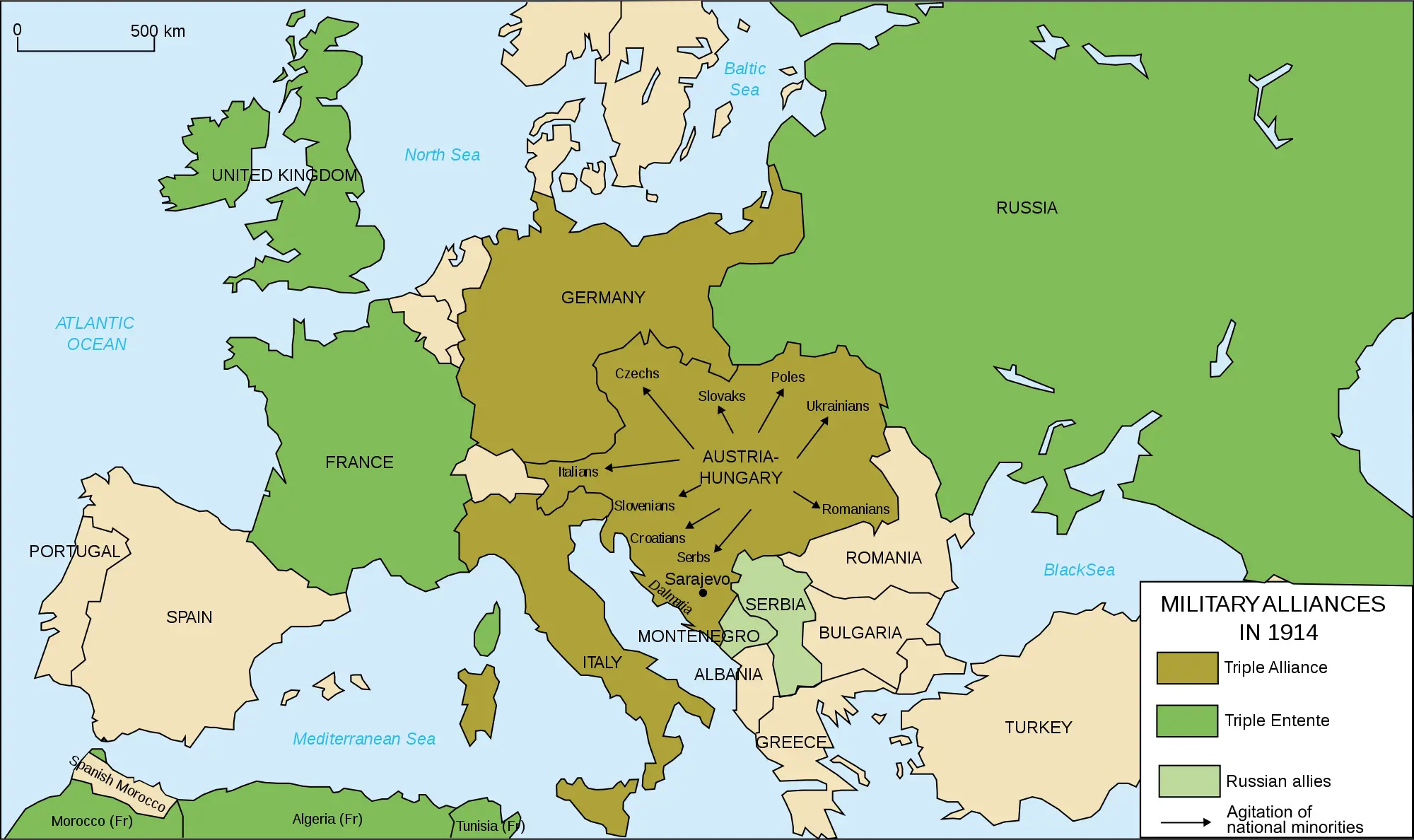
1914 Europe.


^_^


The conflicts between Austria-Hungary and Serbia chiefly concerned the ownership of Bosnia and Herzegovina. The Serbs, a nationalistic people, believed they had a natural right to the two provinces. A group of Serbs formed a secret society called ‘the Black Hand’ that attempted to terrorise Austro-Hungarian officials into satisfying Serbia’s territorial aims. Shortly before noon on Sunday, June 28, 1914, Archduke Franz Ferdinand, heir to the throne of Austria-Hungary was assassinated by Gavrilo Princip, a young Bosnian student part of the group.  Austria-Hungary suspected its small neighbour, Serbia, and as a result, declared war on Serbia on July 28, 1914.

In 1882, Germany, Austria-Hungary and Italy signed a treaty called the Triple Alliance. It was designed to protect against French and Russian attack.
France succeeded in bringing Great Britain and Russia together. The new agreement linking France, Russia and Great Britain was called the Triple Entente.

It is extremely complicated to explain who declared war on whom so we broke it down:

June 28 Archduke Frances Ferdinand was assassinated.
July 28 Austria-Hungary declared war on Serbia.
July 30 Russia ordered general mobilisation.
Aug. 1 Germany declared war on Russia.
Aug. 3 Germany declared war on France.
Aug. 4 Germany invaded Belgium. Great Britain declared war on Germany.


Though allied to Germany and Australia, Italy was able to avoid entering the fray and declared a policy of neutrality for a while before much later, declaring war on Austria-Hungary.

What was intended as a strictly limited war between Austria-Hungary and Serbia, ended up with the Central Powers at war with the Allies, with some countries who copped some flak from Austria-Hungary. These causes included the growth of nationalism, the system of military alliances that created a balance of power, the competition for colonies and imperialism.
The sacrifice of eleven million achieved nothing, succeeding only in laying down the foundations for another bloody conflict 20 years later. An armistice ended the fighting four years later.


>_<

Thanks to:
The World Book Encyclopaedia 1984, World War I, Volume Twenty-One, World Book
Credit to Horrible Histories for the entry title :D

J.T
Last night there were double eps on Horrible Histories (ABC 3 :DD) and there was this funny section about how all the countries got involved. Click here.